
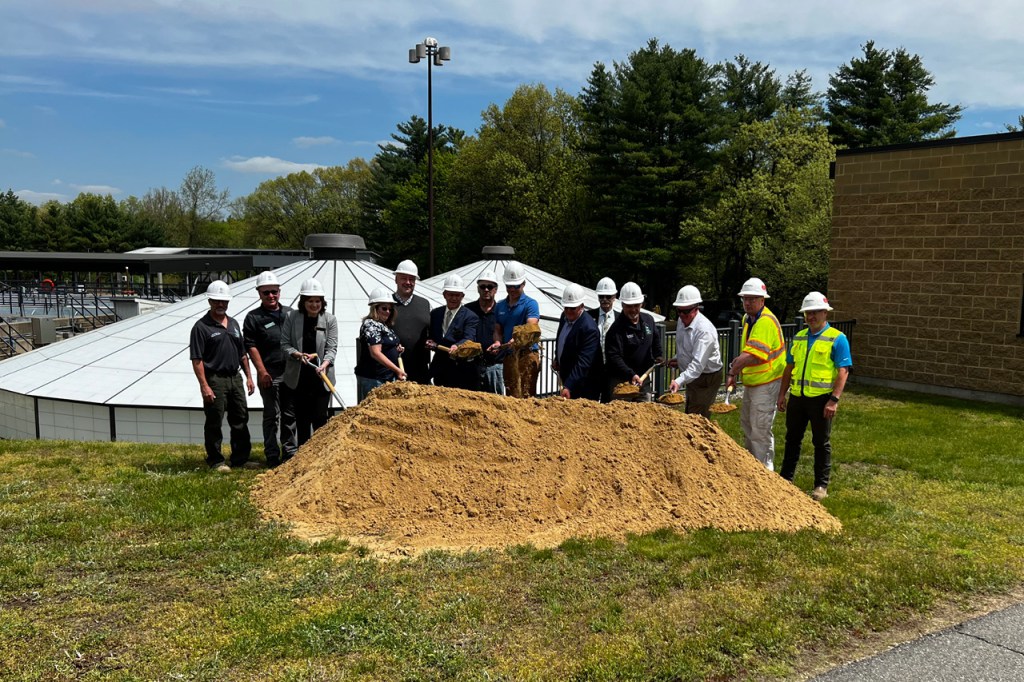
The Town of Milford celebrated a significant milestone today with a groundbreaking ceremony to mark the start of construction on long-planned upgrades to the Milford Wastewater Treatment Facility (WWTF).
Built in 1980–1981 and brought online in 1982, the original facility was constructed under the federal Clean Water Act with a $6.7 million investment, alongside $7.8 million for nearly 78,000 feet of sanitary sewer collection. For over 40 years, the facility has operated 24/7, serving the community and protecting local water resources.
The facility upgrades will bring the WWTF into compliance with the updated U.S. Environmental Protection Agency (EPA) National Pollutant Discharge Elimination System (NPDES) permit requirements, issued in November 2020. These stricter discharge limits are designed to reduce phosphorus and metals in the treated wastewater that is discharged to the Souhegan River, a key tributary of the Merrimack River and a vital drinking water source for Milford and surrounding communities.
“We’re proud to be taking this next step to ensure our wastewater infrastructure keeps pace with the needs of the environment and the community,” said Jim Pouliot, Water Utilities Director. “This project represents a forward-looking investment in sustainability, resilience, and public health.”
The improvements will include the installation of an advanced treatment process and modernization of aging infrastructure across the plant, such as sludge storage and odor control facilities, secondary treatment aeration system improvements, electrical upgrades, and improved process operations. These improvements will enhance operational efficiency, reduce energy consumption, and improve staff safety.
The project was informed by a multi-year study funded in part by more than $600,000 in American Rescue Plan Act (ARPA) grant funds. It included evaluation and piloting of advanced technologies and site visits to similar facilities around New England. Hoyle, Tanner & Associates, Inc. is the design engineer of record, and RH White, the general contractor.
The Town of Milford has secured 15% loan forgiveness for the project and will seek an additional 20% through a State Aid Grant once the project is completed. The Town of Wilton, which benefits from Milford’s wastewater treatment system, will contribute nearly 15% of the project cost (after grants and forgiveness). The remaining cost will be financed through the New Hampshire Department of Environmental Services’ low-interest loan program.
“Cost-sharing between state and federal sources, neighboring towns, and local ratepayers is essential to tackling a project of this scale,” said Milford Water & Sewer Commission Chair, Dale White. “Delaying these improvements would only increase the financial burden down the road.”
The upgraded facility is expected to serve the Town of Milford and its neighbors for the next 20 years, supporting both residents and the local economy—including commercial and industrial businesses that depend on reliable wastewater treatment.
About the Milford Wastewater Utility Department (MWUD):
MWUD has operated and maintained the Milford Wastewater Treatment Facility since it opened in 1982. The Department is committed to protecting public health and the environment by delivering high-quality wastewater treatment and investing in sustainable infrastructure.
 Milford NH Wastewater Treatment Facility